IRA One-Rollover-Per-Year-Rule

Can the “IRA One-Rollover-Per-Year-Rule” affect the division of property?

The IRS new rule “IRA One-Rollover-Per-Year-Rule” may affect the division of property in a divorce.  We use to think that dividing an IRA was simple, there was no need for a QDRO, just the language in the Divorce Decree.  Well, effective as early as January 1, 2015 an individual will only be allowed to make one rollover from an IRA to another (or the same) IRA in any 12-month period.  You will, however be allowed to continue to make trustee-to-trustee transfers between IRAs.  You can also make as many rollovers from traditional IRAs to Roth IRAs as you want.

The Tax Court recently held that you CAN NOT make a non-taxable rollover from one IRA to another if you have already made a rollover from any of your IRAs in the preceding 1-year period (Bobrow v Commissioner, T.C. Memo 2014-21).  Following this decision means:

  • You must include in gross income nay previously untaxed amounts distributed from an IRA if you made an IRA-to-IRA rollover in the preceding 12 months, and
  • You may be subject to the 10% early withdrawal tax on the amount you include in gross income.

Additionally, if you pay these amounts into another (or the same) IRA, they may be:

  • Excess contributions, and
  • Taxed at 6% per year as long as they remain in the IRA.

The IRS indicates that this change will not affect an individual’s ability to transfer funds from one IRA trustee directly to another, because this type of transfer isn’t a rollover.  Per the IRS the one-per year limit does not apply to:

rollovers from traditional IRAs to Roth IRAs (conversions)

  • trustee-to-trustee transfers to another IRA
  • IRA-to-plan rollovers
  • plan-to-IRA rollovers
  • plan-to-plan rollovers

If you are in the process of settlement negotiations, and were expecting to have a final trial or mediation after January 1, 2015, you will want to take this change into consideration.  If your trial date or mediation is already scheduled contact the trustee of the IRAs and determine 1) what type of IRAs you are dealing with, 2) if a party can open an IRA and have funds transferred into the new account without being considered a rollover, 2) if your client is eligible to open the IRA in their name or in the name of their spouse, 3) how long it will take to set up the new account, 4)  if they have a standardized form indicating that the action to be classified a transfer and not a roll-over, 5) what is the verbiage that needs to be in the divorce decree for this action to be classified a transfer and not a roll-over.

If your client is the receiving party and they are not allowed to set up an IRA through that particular trustee they will need to contact another institution and find out exactly what they will need to do to accomplish the division to be classified as a transfer and not a roll-over.  If it is deemed that no matter how the division is handled your client will be affected by the “IRA One-Rollover-Per-Year Rule” you will need to adjust the value based on the potential tax risk.

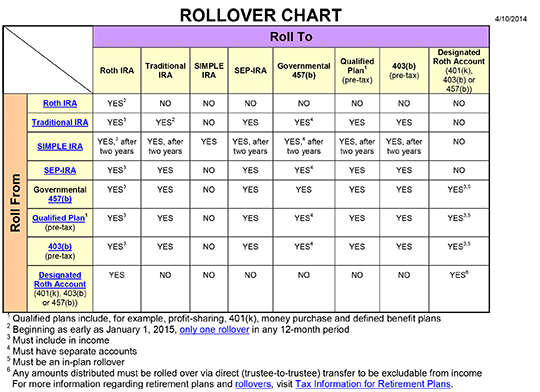
Below is the current IRS ROLLOVER CHART:

Rollover Chart


Posted in Articles, DFW Divorce Finances | Tagged , , , , , , , , , | Comments Off on IRA One-Rollover-Per-Year-Rule

Help Someone Smile

Help Someone Smile

Help someone smile only takes a smile on your face.  During this emotional time seeing other people smile will brighten your day; it will help you remember that the future can be bright.

To see someone smile is as simple as smiling at them.  There are very few people who will not give a smile back when you smile at them.  It can be a stranger on the street, in an 71elevator, a co-worker, a friend or a family member.  All you need to do is keep a moment in your mind that makes you smile, it can be your child’s performance in a school play, your pet chasing it’s tail, it can be anything.  When you see someone simply bring that thought to your mind and you will have a genuine smile on your face which will put a smile on someone else’s face.  It becomes a win win moment.

There is research going on  to see if a smile may actually be able to cause a happy feeling.  Let us know if you feel happy when you see someone smile or when you yourself smiles.

Posted in DFW Divorce Finances, Weekly Tips | Tagged , , , , , , , | Comments Off on Help Someone Smile

It’s a New Year….

It’s a New Year and it is time to …..

Kitchen Drawer


For the next couple of weeks you will be receiving W-2’s, 1099’s, K-1’s (and the list goes on) from your employers, financial institutions, mortgage companies (and this list also goes on).  Make sure that you get, your attorney or financial adviser, copies of all of these documents as soon as possible and while you are at it if your attorney is still needing documents this is the time to pull them all together.

If you are in the process of divorcing you probably cannot discard documents relating to you or your spouse, but that does not mean that you cannot begin to “Clean Out The Past” by organizing and packing up those documents to prepare for your Future.

Posted in DFW Divorce Finances, Weekly Tips | Tagged , , , , , | Comments Off on It’s a New Year….

Preserve Energy

PRESERVE ENERGY

Please Lord, Hear my Prayers. I am tired!!! I need you!!!

Please Lord, Hear my Prayers.
I am tired!!! I need you!!!

Now is the time for you to preserve all the energy you can muster.  Don’t waste  your precious energy on gossip, issues of the past, negative thoughts or things that you cannot control.  During the divorce process you will probably feel that you have lost total control of your life and sometime you will.  Instead of wasting energy on negative issues invest your energy in the positive present moments.

Posted in DFW Divorce Finances, Weekly Tips | Tagged , , , , , , | Comments Off on Preserve Energy

Eating Right

EATING RIGHT

What is eating right???  Well there is a saying “Eat breakfast like a king, Lunch like a prince and Dinner like a college kid with a maxed out charge card”.  This is good advice whether you are going through a divorce or not.  But if you are going through the divorce process it is especially good advice during this emotional time period.

BreakfastBy eating your largest meal in the morning you eat less throughout the day and you will end up not going to bed on a full stomach which will help you sleep better.  Getting a good nights sleep while going through a divorce is vital to good health and a good attitude.  A rested individual will have a positive effect on your children, family, friends, co-workers, etc.

Posted in DFW Divorce Finances, Weekly Tips | Tagged , , , , , , | Comments Off on Eating Right

Spousal Support or Child Support

Will the IRS Recognize the Payments you Make as “Spousal Support” or “Child Support”?

While going through a divorce most couples and their attorneys’ attempt to amicably settle the financial matters prior to going to final trail, so the settlement can be a win/win for both parties.  More and more couples are choosing to use Collaborative Law in an attempt to settle these issues, while some attorneys will suggest to their client that they attempt to reach a settlement through informal settlement meetings and negotiations or go to mediation.  If there is a child or children involved, the usual main issues to be resolved are access with the child(ren) and the amount of child support that is going to be paid or what expenses for the child are necessary and who is going to pay for which expenses.

81While a divorce settlement is being negotiated, no matter what process is being used, the arguments will be (1) what are the child(ren)’s true needs and (2) what will it cost to maintain the child(ren)’s life style.  During the negotiations the party receiving child support will attempt to get the most child support they can, while the paying party will attempt to minimize the amount they will be contractually obligated to pay.  The person obligated to pay child support will be told by the receiving party that the child support offered or the court guideline amount will not be enough to maintain the child(ren)’s life style.

During the negotiations it may be suggested that the payer make alimony payments to the payee instead of paying additional child support.  The argument is usually made to the payer that they will be able to deduct the alimony payment from their gross income for tax purposes.  While the argument made to the payee is that they will receive more than what the Court’s may award, due to the state guidelines.  This may sounds like a win/win situation; the problem is the payer may face tax consequences in later years.

If the payer agrees to pay “Spousal Support” and the total amount or any part of the amount of spousal support to be paid, ends or is decreased when the child(ren) reaches the age of 18 or 21, leaves the household, gets married, dies, or for any other reason concerning the child, the Internal Revenue Service may deem these payments or a part of these payments  as child support; at which time the payer would owe additional federal income taxes and possible penalties and interest while the payee would be owed a refund for federal income taxes paid.  The same rule applies if the reduction called for is to occur at a time that can clearly be associated with such contingency.

According to the Internal Revenue Service Code, Alimony Payments §772. Divorce and Separation Instruments.  Payments made under a divorce or separation instrument are includible in the gross income of the recipient and deductible by the payor if the following requirements are met: (1) the payment is in cash or its equivalent, (2) the payment is received by or on behalf of a spouse under a divorce or separation instrument, (3) the instrument does not designate the payment as not includible in gross income and not allowable as a deduction under Code Sec. 215, (4) spouses who are legally separated under a decree of divorce or separate maintenance cannot be members of the same household at the time the payment is made, (5) there is no liability to make any payment for any period after the death of the payee spouse or to make any payment (wither in cash or property) as a substitute for such payments after the death of the payee spouse, and (6) the spouses must not file joint returns with each other (Code Sec. 71 (a), (b) and (e)).

Further according to the Internal Revenue Service Code Child Support is defined as §776. Child Support. Payment made that fix an amount or a portion of the payment as child support qualify as child support for tax purposes and are not deductible by the payor or taxable to the payee (Code Sec. 71©).  If any amount specified in the instrument is to be reduced based on a contingency set out in the instrument relating to a child “ such as attaining a specified age, dying, leaving school, or marrying “ the amount of the specified reduction is treated as child support from the outset.  The same rule applies if the reduction called for by the instrument is to occur at a time that can clearly be associated with such contingency.  Thus, payments that vary with the status of a child are not deductible.

Example: A divorce instrument provides that alimony payment will be reduced by $500 per month when a child reaches age 18.  Under these circumstances, $500 of each payment is treated as child support.

You may think to yourself “okay we can get around this, we will just have the alimony end a month prior to or a month after the child reaches the age of 18″.  The problem with that line of thought is; it states in  776. Child Support – …is to occur at a time that can clearly be associated with such contingency.  Clearly associated with such contingency are “Payments that would otherwise qualify as alimony are presumed to be reduced at a time clearly associated with the happening of a contingency relating to the child only in the following situations.” 

  • The payments are to be reduced not more than six months before or after the date the child will reach 18, 21, or local age of majority.
  • The payments are to be reduced on two or more occasions that occur not more than one year before or after a different one of the children reaches a certain age from 18 to 24.  This certain age must be the same for each child, but need not be a whole number of years.

In all other situations, reductions in payment are not treated as clearly associated with the happening of a contingency relating to the child. (2010 Tax Issues of Divorce, p. 58)

If the period of alimony payments is customary in the local jurisdiction, the presumption can be overcome and the payment may be treated as alimony.  Texas Family Code §8.054 – Duration of Maintenance Order clearly states that the order for maintenance may not remain in effect for more than three years after the date of the order.  So if you were to enter into an agreement whereby you were going to pay your spouse alimony for three years and the alimony payments would terminate the month the child’s turns 18, the Internal Revenue Service may deem all of the alimony payments as alimony.  The Internal Revenue Service could also take into consideration Texas Family Code §8.051 “ Factors in Determining Maintenance which describes the relevant factors to determine the need for Spousal Support/Alimony which to name a few includes the parties’ financial resources, the length of the marriage, the education and employment skills of the spouses, the age and employment history of the spouses, the ability to meet personal needs, custodian of a child or children who requires substantial care and personal supervision because a physical or mental disability that makes it necessary that the spouse not be employed outside the home and the lack of earning ability in the labor market, at which time the Internal Revenue Service may still deem all or part of the alimony payments as child support.

If you still have questions after reading these blog posts, please call Cathy A. Threadgill who will be able to help you with your specific situation.

All articles/blog posts are for informational purposes only they do not constitute legal advice. If you require legal advice, please contact a lawyer licensed in your state. The opinions expressed here are solely those of the author, who is not an attorney.

Posted in Articles, DFW Divorce Finances | Tagged , , , , , , , , | Comments Off on Spousal Support or Child Support

Life Isn’t Fair

Life Isn’t Fair

Now is the time to realize that LIFE isn’t always FAIR, but it can still be good.

Bad things do happen to good people, or what you may perceive as a “bad” thing may happen to a good person.  That “bad” thing commonly known as a divorce may actually be the best thing to happen to you if you can look past the hurt, anger, betrayal, and lies to see what life has in store for you.

Scales of Justice w Books #5

Most people who have been divorced for three or more years will tell you that their lives are better now than when they were married.  Their lives may not be easier but they are better.


Posted in DFW Divorce Finances, Weekly Tips | Tagged , , , , | Comments Off on Life Isn’t Fair

Life is Short so Forgive

Life is short so forgive…

Life is too short to waste your time hating anyone.  Forgive your ex or soon to be ex for everything.  This doesn’t mean to forget just forgive.

Water LilyForgiveness is not for the other person it is for you.  Hanging on to hatred is not healthy, emotionally or mentally.  It will age you beyond your years and affect your entire life.  By releasing those feeling you will be a happier person, have a brighter out look on life, feel younger and better about yourself.

How do you forgive someone that you feel lied to you, betrayed you and wrecked your life; start by realizing that they gave to you the best they had to give at the time.  No one is able to give you everything you need all the time.  Then remember them the way they were and realize that that person no longer exists.  Realize that forgiveness does not happen overnight so when you are sitting their saying I have tried to forgive but I just can’t, keep trying and one day you will forgive.  Every time you think about them, in your heart and in your mind send them a prayer for happiness, send them your love and let go of the anger.

Someone once told me to write a letter to the certain someone.  Spell it all out, put it in writing, write about all of the love, the precious memories, the heart aches, and the loss, all ranges of your emotions, be brutally honest within this letter.  When you are finished put it away for a week and then take it out and re-read what you wrote, feel the pain and anger again.  Then tear up the letter and then burn it, release those feelings within the flames and as the flames die down realize that you don’t have to hang on to those feelings and emotions anymore.  They are gone.

Posted in DFW Divorce Finances, Weekly Tips | Tagged , , , , , | Comments Off on Life is Short so Forgive

Don’t Win Every Argument

Don’t win every argument…

It is not necessary to win every argument and when you are going through a divorce you should always choose your battles wisely.

Let’s look at a couple of examples:

EXAMPLE 1.  Your Ex claims that you are controlling.  If you argue this point with them you may appear to be controlling and not able to handle criticism, but if you accept the fact that in their view you are controlling and respond by saying “Okay, you feel that I am controlling, I accept that”.  You will definitely accomplish two things, first you accept their feelings and two you end an argument.

2.  You and your Ex are arguing over possession, specifically a dinning room set.  You really want it well if you end the argument and allow your Ex to take possession of the dinning room set you will probably save yourself a lot of heart ache and money, you will be taking one step forward on starting your life fresh and new and if your Ex was just pushing your buttons they loose.

Choose your battles and don’t expect to win every argument.

Posted in DFW Divorce Finances, Weekly Tips | Tagged , , , , , , , , , | Comments Off on Don’t Win Every Argument

Make Peace With Your Past

Make Peace With Your Past

What you are going through now will soon be a part of your past, so make peace with it now, so it doesn’t spoil the future and while you are at it, now is a good time to make peace with your past so it will stay there.

KONICA MINOLTA DIGITAL CAMERA

Take time to look at your past and realize that your past is your past and there is probably not much that you can do to change that.  You may be able to contact those that you owe an apology to, but you cannot force those who owe you an apology to apologize.  You cannot make your parents change the way they raised you but you can accept that they probably did the best that they could do at the time, or the best that they knew how to do.  Accept that you are no longer the person you were in the past and realize that you may or may not handle the same situation the same way, knowing how things can turn out.

If you gave the best that you had during your marriage accept that you gave it your all, and if you didn’t give your all then realize that maybe if there is another relationship in your future that you could give more or maybe you need to give in another way.

What has happened has happened and cannot be changed, BUT you can change so the cycle stops.  If you don’t take the time to review your past and accept it, you are bound to make the same mistakes again.


Posted in DFW Divorce Finances, Weekly Tips | Tagged , , , , , | Comments Off on Make Peace With Your Past